
 CALL US NOW
 EMAIL US NOW
Divorce Lawyer Assisting Clients in Bedford, Texas, and Tarrant County
Divorce can be one of the most wrenching and life-altering processes that a person can go through. It doesn’t have to be that way, though. The adversarial or legal model of divorce is only one way to finalize a divorce. There are other ways that agreement can be reached through negotiation or mediation, in a process called collaborative law. In collaborative legal processes, the parties maintain a great degree of control, deciding what they can agree to and what is non-negotiable. In an adversarial divorce process, however, many decisions are made by a judge, with no control retained by the divorcing parties. Whenever possible, experienced family law attorney Anita Cutrer will help divorcing couples negotiate a divorce settlement without having to subject themselves to the court system. In cases where agreement cannot be reached, however, Ms. Cutrer is well-prepared to go to trial and fight for a favorable outcome.
Contact Anita K. Cutrer, Attorney at Law, today for legal assistance at 817-854-1651 to get the help you need in finalizing your divorce.
What Kinds of Divorce Are There in Texas?
There are a few types of divorce proceedings in Texas. They include:
Uncontested Divorce—When a couple is divorcing amicably and can agree on all issues of property, debt division, child custody, and ongoing support, they can have what is known as an uncontested divorce. This is the fastest and least costly method of finalizing a divorce.
Collaborative Law—In Tarrant County, we offer collaborative law. Collaborative law is for people who can’t work out the details of the divorce on their own but are not so far apart that they feel that they must go to court to have their issues decided. Instead, they enlist the help of a mediator or divorce lawyer to assist them in negotiating agreements. Any settlement of a case is by nature a negotiation and is full of trade-offs. Collaborative law provides a process whereby both parties can work toward the optimum solution for each of them in a safe environment—safe physically, but also safe that one will not be intimidated, talked over, belittled, or ignored in the discussion.
Contested or Litigated Divorce—A contested or litigated case usually starts with one spouse filing for divorce, possibly on fault grounds. The couple cannot agree on terms, so they must turn to the court to resolve their differences.
Which of these options fits your particular situation is a question for discussion between you and your Bedford divorce lawyer.
What Are Legal Grounds for Divorce in Texas?
According to the Texas Family Code, a divorce may be sought on “fault” or “no-fault” grounds.
There are 3 no-fault grounds for divorce in Texas:
- In supportability (i.e., incompatibility): either spouse feels that the marriage has become insupportable because of discord or conflict in personalities which makes reconciliation impossible.
- Living apart: the spouses have lived apart for three years or more.
- Confinement to a Mental Hospital: One spouse has been confined to a mental institution for at least three years and is unlikely to improve.
In these three cases, the court does not ascribe fault to either party.
There are 4 fault grounds for divorce in Texas:
- Cruelty: cruel treatment of the spouse that was of such a nature that it renders further living together insupportable
- Adultery: one spouse cheating on the other
- Felony Conviction: one spouse is convicted of a felony during the marriage and in prison for at least one year in a department of criminal justice or a state or federal penitentiary, and they haven’t been pardoned. However, if the state’s case against the convicted felon was based on his or her spouse’s testimony, a divorce cannot be granted on felony conviction grounds.
- Abandonment: the at-fault spouse must have left voluntarily with the intent to abandon the spouse who filed. The abandonment must have been continuous for a one-year period.
Whether a divorce is sought on fault or no-fault grounds can affect the division of assets, child custody, and other aspects of the case. It is best to consult with a skilled divorce lawyer before deciding the grounds on which to file for divorce.
What Are The Requirements for Obtaining a Divorce in Texas?
While many states require a period of separation before divorce papers can be filed, there is no separation requirement to file for divorce in Texas. As long as one spouse has lived in the state for six months and has been a resident of the county for 90 days, the divorce can be filed. However, a spouse who lives outside the state may file a case against a spouse who does live in Texas as long as that spouse meets the residency requirements of six months’ residency in the state and 90 days in the county.
For those in the military, Texas residents who are stationed outside of Texas may still be considered Texas residents. Military personnel who have not previously resided in Texas, but have been stationed at one or more Texas military bases for at least the last six months and at a military base in a county of Texas for the previous 90 days, are considered Texas residents and residents of that county for the purpose of filing a divorce.
As far as timeline requirements, no divorce in Texas will be finalized less than 60 days after the date of filing. Even in an uncontested divorce where both parties are in full agreement on all terms, 60 days from filing is the required minimum time period before your divorce will be finalized.
How Long Does a Divorce Take in Texas?
In Texas, the average divorce proceeding lasts six months to a year, with most of the time spent finalizing paperwork.
For one, a divorce is not finalized until at least sixty days after the petition is filed—most last only slightly longer, with the small minority skewing the average.
A typical divorce timeline, from the perspective of one spouse filing, should go something like the following:
- Get a family law attorney to write up a petition/complaint. This covers grounds for divorce and how the spouse wants to settle issues such as custody or finance.
- After the lawyer files the petition/complaint, the petition is served to the other spouse, along with a court summons that requires a response.
- The spouse has a certain time limit to respond. The response will answer whether the spouse agrees to the terms or not. If the spouse does not answer, the court assumes they agree.
- The couple exchanges information and documentation about their property or income for the court to determine such things as alimony and child support, if any.
- Mediation or settlement between parties
- If the judge agrees, they issue a divorce decree. If not, or the couple cannot reach an agreement, the case goes to trial.
- There is a divorce trial, where attorneys present arguments for both sides. Once the judge reaches a decision, they grant a divorce.
- Either spouse can appeal the judge’s decision to a higher court.
How is Anita K. Cutrer Different from Other Divorce Attorneys?
Attorney Anita Cutrer is Board Certified in Family Law by the Texas Board of Legal Specialization and has practiced Family Law matters for more than 20 years. Ms. Cutrer only takes divorce cases for those who reside in Tarrant County, Texas. This gives her and her clients the advantage, as she knows each judge and their policies going in. This comprehensive knowledge of the Bedford, TX region gives her the edge over attorneys who spread themselves thin over large geographic and practice areas. Anita Cutrer does family law in Tarrant County only, and that makes her the knowledgeable choice to be your experienced divorce attorney.
Each year, 75,000 people divorce in Texas, and 40 to 50 percent of all first-time marriages end in divorce. You are not alone. Anita K. Cutrer, Attorney at Law, is here to guide you through the complicated process of finalizing your divorce in Bedford, TX so you can get on with your life.
For a consultation, contact us online or call our Bedford divorce lawyers today at 817-854-1651 for legal representation.

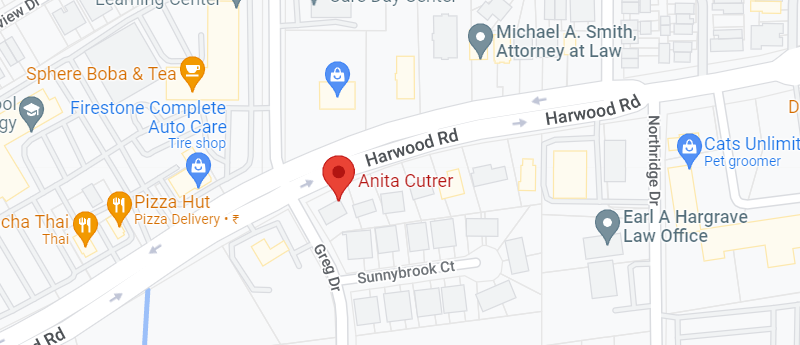
 304 Harwood Rd
 anita@akcfamilylaw.com
 817-854-1651